How Autofocus-Zoom Cameras Transform Vision Systems for AGVs, AMRs & ROVs
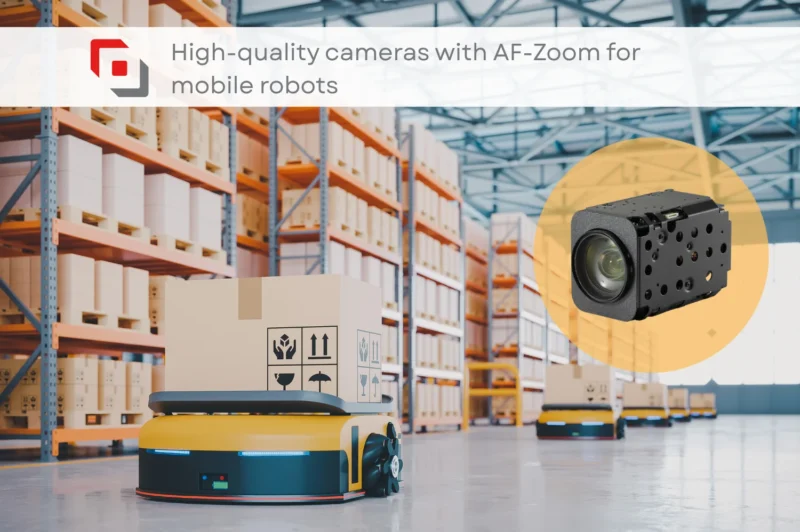
Vision systems for mobile robotics are evolving to keep pace with developments in Automated Guided Vehicles (AGVs), Autonomous Mobile Robots (AMRs) and Remotely Operated Vehicles (ROVs).
Mobile robots operate in dynamic, unpredictable environments. They move through aisles, approach pallets, dock at stations, and even monitor crops. Their cameras must perform reliably while dealing with changing object distances, variable lighting conditions, obstacles and mechanical movement.
A robot may need to verify a pallet label from two meters away, then inspect docking alignment at close range seconds later. Fixed-focus lenses struggle here as they are optimized for only one focal distance.
This results in blurred images, unreliable barcode reads, compromised AI accuracy, and unnecessary delays.
Autofocus-Zoom Cameras Overcome the Limitations of Fixed-Focus Lenses
Fixed-focus cameras force system designers into a trade-off:
- Wide field-of-view gives greater coverage, but less detail
- Narrow field-of-view gives sharper detail, but limited coverage
Integrators can compensate by adding multiple cameras, increasing system complexity, cost, and installation time.
However, autofocus technology eliminates the constraint of a single focal plane. As the AGV or AMR approaches or moves away from an object, the camera automatically adjusts focus in real time to maintain image sharpness.
Operational benefits:
- Reliable barcode and QR code reading at varying distances
- Accurate label verification without repositioning the robot
- Improved image clarity during motion
- Reduced manual intervention
Instead of designing workflows around camera limitations, robots can operate freely while vision adapts automatically.
Visit our Tech Focus blog on autofocus-zoom to learn how the technology works and what affects its performance.
The Advantages of Optical Zoom
Optical zoom adds another layer of flexibility. Rather than physically moving closer to capture detail, the camera can zoom in to extract the required information.
This enables advantages such as pallet inspection from a safe distance, reading small text without interrupting workflow and remote operator verification.
For robotics OEMs and system integrators, this means one AF-Zoom camera can replace multiple fixed-focus units, reducing hardware complexity and simplifying integration.
In our Tech Focus blog on optical zoom and digital zoom we discuss/explain the differences between the two.
Enhancing AI and Machine Vision Performance
Modern automated and autonomous robots increasingly depend on AI-driven vision systems for object recognition, navigation validation, obstacle detection, and automated inspection. However, in machine vision, input quality directly determines output reliability; blurred, poorly focused images inevitably reduce detection accuracy and increase processing errors.
Block cameras ensure that images remain sharp across varying distances, angles, and motion conditions. In this way, they provide high-quality visual data to onboard processors and edge-AI systems. This strengthens object detection models, enhances accuracy of barcode and label recognition, and reduces the likelihood of false positives or misclassification.
By adapting dynamically to its environment, the AF-Zoom camera enables machine learning models to perform more predictably, even in complex real-world scenarios.
Sharper images also improve training data quality. When captured data is clear and well-focused, datasets become more reliable, enhancing long-term system performance. Over time, this translates into smarter robots, more stable automation workflows, and fewer costly interruptions.
Designed for Integration in Industrial Robotics
Performance and easy integration are all key benefits of AF-zoom cameras, which are engineered to support:
- Fast focus response times
- High optical zoom
- Features to optimize performance in low light
- Low latency streaming
- Compact form factors for mobile platforms
- Standard industrial interfaces (e.g., USB3, HDMI, Ethernet IP)
- SDK and API control for programmable control
- Options for rolling or global shutters to suit static or dynamic image capture
This flexibility reduces commissioning time, streamlines system architecture, and allows teams to standardize on a single adaptable vision solution rather than managing multiple fixed-focus variants. This results in accelerated development cycles and simplified long-term support.
Vision That Scales with Automation
As automation expands, expectations rise. AGVs, AMRs and ROVs are no longer limited to simple point-to-point transport. They are becoming intelligent, adaptive platforms operating in complex ecosystems. Their vision systems must match that intelligence.
Harrier autofocus-zoom cameras enable robots to zoom in and focus on the area of interest, adapt in real time, and deliver consistent performance across diverse applications. A variety of outputs, plus the added flexibility offered by our Harrier Interface Boards, means that the cameras can be easily integrated in existing systems. With zoom from 10x to 55x, modules with global shutter sensors, up to 4K resolution, and camera control options ranging from VISCA to Pelco, UVC and ONVIF control, there’s an ideal Harrier camera for your robotics application.
If you’re developing or upgrading an automated vehicle or mobile robot platform, take a look at our range of block cameras to find the right one for your requirements.