Lucky Star Gazing – High-Speed Imaging in Astronomy
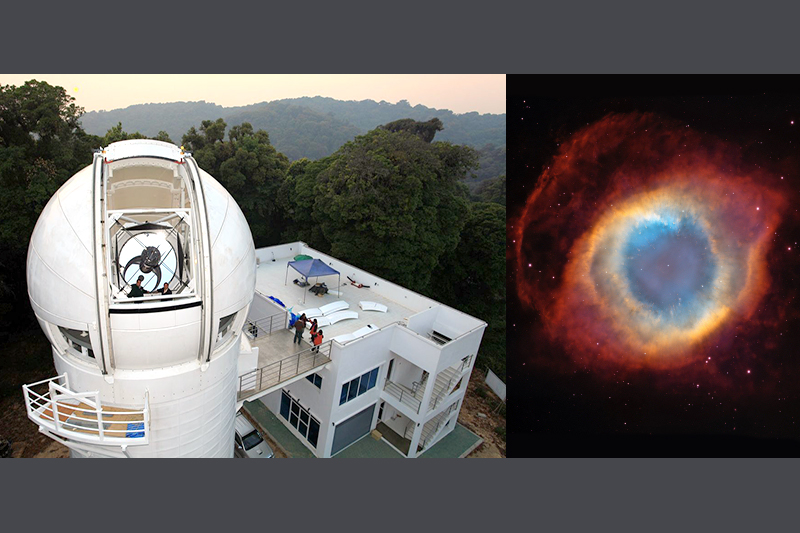
Although stars are not exactly whizzing about in the sky, high-speed cameras provide an important tool for gaining high-res images of astronomical objects.
Most telescopes are based on Earth and so the resolution of images taken by these ground-based telescopes are influenced by the distortion the light undergoes by passing through several kilometres of turbulent atmosphere. This results in a much lower resolution than can be expected from a space-based instrument, such as the Hubble Space Telescope.
One method to overcome the blurring effects of the atmospheric turbulence is “Lucky Imaging”. Images are taken with a high-speed camera using exposure times short enough (100ms or less) to ensure the changes in the Earth’s atmosphere during the exposure are negligible.
If thousands of images are taken, there are likely to be several frames where the object in question is in sharp focus due to the probability of having less atmospheric turbulence during the short exposure period of the “lucky” frame. By taking the very best images, for example, 1% of the images taken, and combining them into a single image by shifting and adding the individual short exposure pictures, “Lucky Imaging” can reach the diffraction limit – the best resolution possible with a particular instrument – in this case, a 2.4m aperture telescope.
MOSCAM is an astronomy project using “Lucky Imaging”. It is a cooperation between Sheffield University in the UK, and NARIT, the National Astronomical Research Institute of Thailand, with the aim to discover faint companions of stars in our solar neighborhood.
For this project, a high-speed Camera Link camera is mounted to the telescope in the Thai National Observatory, which is situated on Thailand’s highest mountain Doi Inthanon. For optimal image acquisition, Active Silicon’s FireBird Camera Link 80-bit frame grabber was chosen along with a 10m passive Camera Link cable also supplied by Active Silicon which was critical to the project. The system performs perfectly at the maximum 80-bit (Deca) acquisition speed even within the sometimes electrically noisy environment.
Active Silicon is a specialist in Camera Link solutions. We can provide acquisition hardware, optimal cabling, and in cooperation with our trusted partner companies, find the right camera for you.