Optimizing UAV Imaging with Autofocus-Zoom Cameras
Imaging is one of the core enabling technologies that defines the capability of a modern UAV. For engineers, the challenge is balancing optical performance, mechanical stability, processing throughput, and payload constraints.
Autofocus‑zoom cameras deliver flexible, high‑resolution, real-time imaging across wide and long‑range scenes. This makes them ideal for dynamic UAV missions in defense, inspection, surveillance, rescue and delivery applications.
Considerations when Selecting an Image Sensor
Selecting a camera with a sensor that is suitable for the application is one of the most important design decisions.
Sensor size directly impacts low-light performance, depth of field, dynamic range, and signal-to-noise ratio. Larger sensors generally improve image quality but increase optical system complexity and payload mass.
Image resolution must also be carefully considered. Higher megapixel counts improve target identification and digital cropping capability, but they increase bandwidth, storage requirements, and processing load. Although higher resolutions are better for visualization (e.g. seeing a distant number plate) they are often not required for AI applications and can in fact reduce their effectiveness.
Frame rate is important for applications involving high-speed motion or object tracking because it determines how frequently image data is sampled over time. Higher frame rates reduce motion artefacts and improve temporal resolution. This enables more accurate tracking and faster, more reliable decision-making in critical situations.
Autofocus‑Zoom Cameras for UAVs
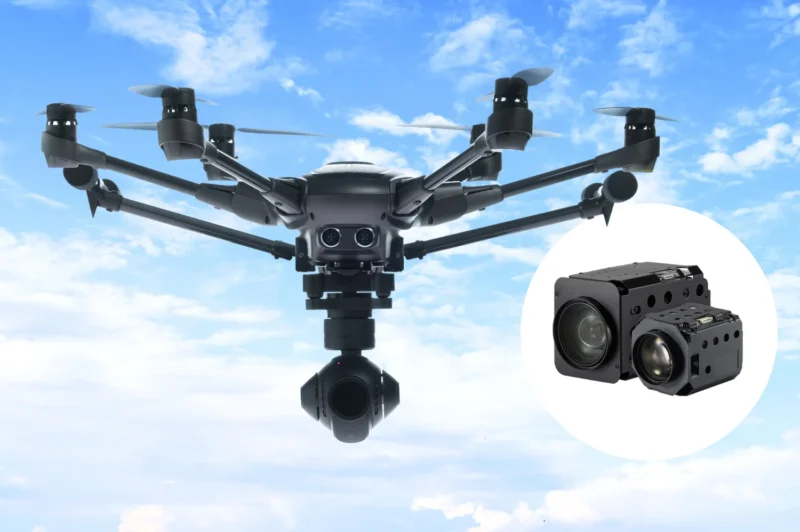
Autofocus-zoom camera modules give UAVs the ability to transition from wide‑area situational awareness to fine‑detail inspection without requiring additional hardware and are therefore highly versatile.
From an engineering standpoint, three elements influence the camera selection:
- Optics and zoom mechanics: Precision lens groups must move smoothly under vibration and acceleration. Zoom ratios of 10x up to 50x are common in professional UAVs, and maintaining optical alignment across that range can be complex.
- Autofocus performance: The scene in front of a moving drone is constantly shifting. If the autofocus system can lock onto the subject quickly, the camera spends more time capturing sharp frames and less time “hunting” for focus. For target tracking, a responsive system can re-acquire focus quickly as the target moves, keeping tracking algorithms supplied with clean, high contrast frames. Increasingly, these algorithms are AI-assisted, processing even more data more quickly.
- Sensor characteristics: As mentioned above, larger sensors improve signal-to-noise ratio (SNR) and low‑light performance. Global shutters mitigate rolling‑shutter artefacts during high‑speed maneuvers. Engineers also need to consider dynamic range, onboard image signal processor (ISP) capabilities, and thermal noise. Thermal management is particularly important in compact EO/IR payloads where sensor noise can increase significantly with temperature. An IR cut filter enables clearer imaging in daylight and some cameras have a removable filter to allow night vision
Gimbal Integration
A high‑quality camera is only as good as its stabilization. When using high zoom, even very small vibrations from the aircraft are noticeable and stabilization is essential for capturing clear images. For this reason, most professional UAVs use 3-axis, stabilized gimbals to compensate for pitch, roll, and yaw movement.
Key design factors include:
- Fast and accurate control systems and motors that react quickly to sudden aircraft movements and avoid overshoot and motion jitter.
- Mechanical damping to reduce high frequency vibration from rotors. Mechanical stiffness of the gimbal, motor precision, encoder resolution and the control software all directly influence image stability and pointing accuracy.
- Reliable communication between the camera, payload and gimbal ensures that zoom and autofocus remain stable while the UAV is moving. Modern gimbals are often integrated with automated tracking and geolocation systems to support fully autonomous operation.
Modular gimbal designs enable different block cameras to be swapped in and out as required.
UAV Imaging in the Defense Sector
Defense applications push imaging requirements further. UAVs used for intelligence, surveillance, and reconnaissance (ISR) must deliver stable, high‑fidelity images and video at long ranges and in challenging environmental conditions. Typical demands include:
- Long‑range optical zoom that maintains image quality and minimizes distortion at high magnification.
- Multi‑spectral integration that combines visible light, IR, and thermal images enabling the UAV to operate in the day, night, in foggy conditions or to deliver application specific images. Sensor fusion can be used to combine data from multiple image sensors to produce a single, more informative, and higher-quality image.
- High‑reliability autofocus that performs well under vibration, high altitude, and rapid repositioning.
- Rugged design to withstand temperature extremes, shock, and electromagnetic interference.
In these missions, the imaging unit is not just a payload – it’s a primary sensor that supports decision‑making, navigation, and threat detection.
Compact, Powerful Imaging Solutions
Harrier autofocus-zoom cameras are ideal for drones because they combine high-performance imaging with low size, weight and power (SWaP) requirements. Compact designs, optical zoom options from 10x to 55x, and support for Full HD and 4K video enable long-range target observation and detailed inspection.
Features of the cameras also include fast autofocus, image stabilization, wide dynamic range (WDR), low-light sensors, and multiple video outputs that offer reliable operation across surveillance, inspection, defense, rescue and remote monitoring applications. Camera interface boards can convert the camera LVDS output to Ethernet IP, SDI, USB, and HDMI formats and simplify fast integration into UAV vision systems.
Our comparison of cameras for UAVs and Gimbals guides engineers to find the right solution for unmanned projects.
Power, Communication and Positioning for UAVs
Active Silicon is part of a group of diverse technology companies who assist our drone customers far beyond just their imaging needs. By leveraging the skills and capabilities of our sister companies within the Solid State Group, we can deliver:
Compact, safe and reliable primary and secondary battery packs. Custom Power’s battery design service means that a bespoke power solution can be developed to fit the space and weight constraints of any UAV.
RF, Microwave and MANET communication networks. Steatite develops and supplies a wide range of antennas and datalink hardware; communication can be guaranteed even in RF-denied environments and challenging terrains.
Position, Navigation, Timing: Steatite‘s portfolio includes highly configurable PNT systems in low power, compact form factors.
Our white paper on Technology for UAVs (PDF) explains the capabilities that we can offer in more depth.