
Are you getting started with CoaXPress over Fiber or starting to use fiber optic technology?
We can help with an introduction to the technology, the cables and connectors. We also explain the acronyms and unfamiliar terms in our white paper:
What is CoaXPress over Fiber and how does it work?
CoaXPress over Fiber (COF) enables the CoaXPress protocol to operate via fiber optic cables instead of using coaxial copper cables.
With the COF bridge protocol, CoaXPress 8b/10b-encoded data is converted to Ethernet 64b/66b encoding, allowing data from four CXP-12 lanes to be carried over a single 40 Gbps (40G) Ethernet link.
Fiber-optic cables and connectors for 40G Ethernet technology are widely available, reducing system costs.
What are the benefits of using fiber optic cables?
Fiber optics utilizes the reflection or refraction of light in a glass fiber and this comes with several advantages compared to copper cables:
- Immunity to electrical noise
- Low signal loss over long distances
- High bandwidth
- Galvanic isolation
These features make fiber optics a valuable asset in machine vision applications.
Compared to copper cables, fiber optic cables are generally smaller in diameter, lighter and have a tighter minimum bend radius.
Another major benefit is future-proofing, as the fiber you install today for CoaXPress over Fiber 40G optics will likely work well with next-generation 100G (100 Gbps) optics.
Basics of fiber optic cables
There are two types of optical fiber for machine vision applications: single-mode and multimode.
Multimode fibers have a wider core diameter and usually use LEDs. This enables cable lengths of a few hundred meters.
Single-mode fibers have a very small core diameter and use lasers. This allows for transmission over several kilometres but at increased costs.
Fiber Optic Cable Assembly for CoaXPress
A fiber optic cable assembly combines the fiber cable with suitable transceivers. For CoaXPress at 40 Gbps, the standard is a QSFP+ port that is 40GBase-SR4 compliant. Such a receiver will work well together with an OM3 or OM4 multimode cable for applications that require cable lengths up to 150m.
Active Silicon offers cable assemblies and accessories that are suitable for machine vision applications.
Implementing CoaXPress over Fiber
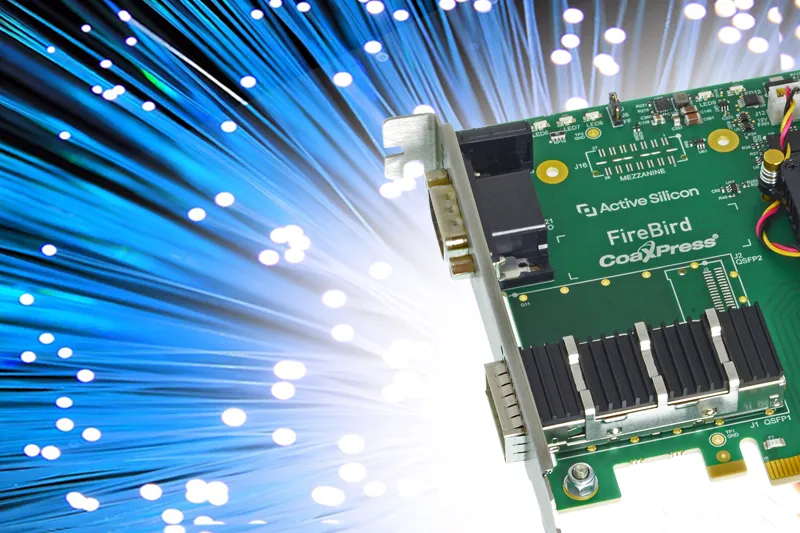
Ready to implement CXP over Fiber? Take a look at our FireBird CoaXPress over Fiber frame grabber options.
Once all components have been sourced, successful implementation of a fiber optic system also depends on practical issues like:
- Correct cable polarity
- Fiber cleanliness
- Proper connector engagement
Check out our White Paper on Fiber Optic Technology for advice on what to consider regarding cabling, connector types and handling of fiber optic equipment, plus troubleshooting.