Solving Agricultural Challenges with Computer Vision
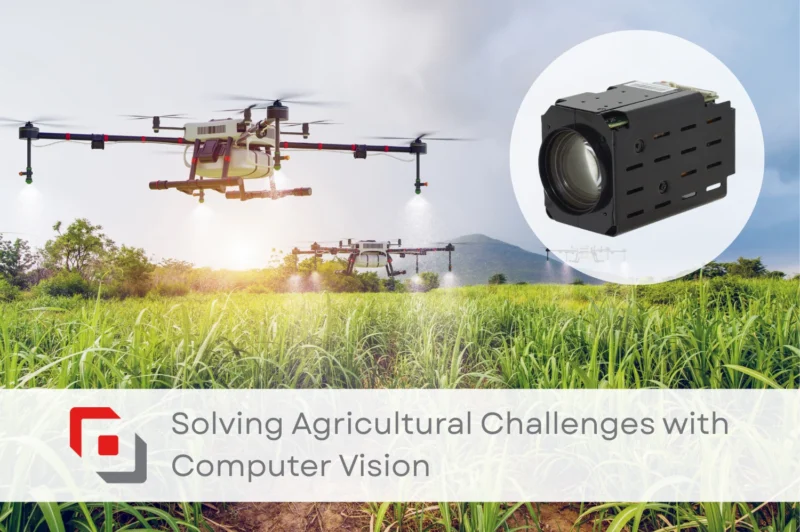
Agriculture is deeply visual. Farmers make many decisions by observing their crops, yet these observations are often limited to manual inspections and small samples of data.
Computer vision changes this by enabling continuous, field-wide monitoring of crops. However, the real challenge goes beyond building accurate models – it’s creating systems that work reliably across different seasons, crop types, lighting conditions, and real-world farm environments.
The Challenges Faced by Farmers
Farming has always operated on tight margins, and today’s global pressures are making those margins even tighter. Climate change is reducing usable farmland, increasing heavy rainfall in some regions while driving drought in others.
At the same time, the cost of fertilizers, pesticides, animal feed, and labor continues to rise. To stay profitable, farmers must use inputs more efficiently, minimize waste, and make smarter decisions across every part of their operation.
Why Turn to Computer Vision?
As costs rise, automation is seen as increasingly important alternative. Computer vision is a natural fit for agricultural applications due to several factors.
Farming is highly visual by nature: plant health, growth stage, spacing and ripeness all require inspection to maximize yields. Animals must also be monitored for signs of disease, or any drop in condition.
Cameras can take some of this visual inspection work off the shoulders of farmers as they offer cheap technology, scalability, and non-invasive procedures. Vision works across multiple platforms including drones, tractors, robots, mobile devices and even satellites.
Modern cameras are highly adaptable, providing options for hyperspectral imaging to monitor ripeness, water content or weed invasion. Cameras for agritech are optimized for imaging in low light and ruggedized for withstanding harsh environmental conditions.
Computer vision can provide key information essential to making timely and cost-effective decisions. Cameras can capture more data in a shorter time period than humans, especially when mounted on UAVs or ROVs. Interpretation of this visual data not only informs but predicts and advises. The increasing adoption of AI means that this visual data can be collected, analyzed and acted upon more quickly and effectively than ever before.
We’ve previously written about the use of hyperspectral imaging in AgriTech, as well animal monitoring, the development of robots and adoption of IoT sensors. These blogs provide a wealth of information about the technology available to the agricultural sector.
Challenges for Agricultural Imaging
Fields are uncontrolled environments and imaging solutions face unique hurdles in agriculture: lighting changes hourly, shadows stretch differently across seasons, soil colors vary, and weather can alter plant appearance overnight.
Crops themselves are highly variable – different varieties, growth stages, and stress responses mean a model trained on one field may fail on another. Imaging solutions must be highly adaptable, and software must consider a multitude of possibilities in modelling.
Additionally, training data for labeling requires sector expertise, making large-scale datasets expensive and slow to produce.
Deployment adds a layer of complexity too. Models often need to run on drones, tractors, or edge devices. These may have limited compute and connectivity.
Predictions must be available in real time and in the field, because delayed or incorrect guidance can lead to crop loss or wasted inputs. Extensive research and thorough testing is essential when developing these systems.
Another challenge is scaling from a single plot to hundreds of hectares. This isn’t trivial and it demands careful calibration, continuous monitoring, and integration with other farm systems like irrigation, GPS, and IoT sensors. AgriTech isn’t just about building a model – it’s building a system that works reliably in the real world.
Use Cases of AgriTech Designed to Improve Efficiency
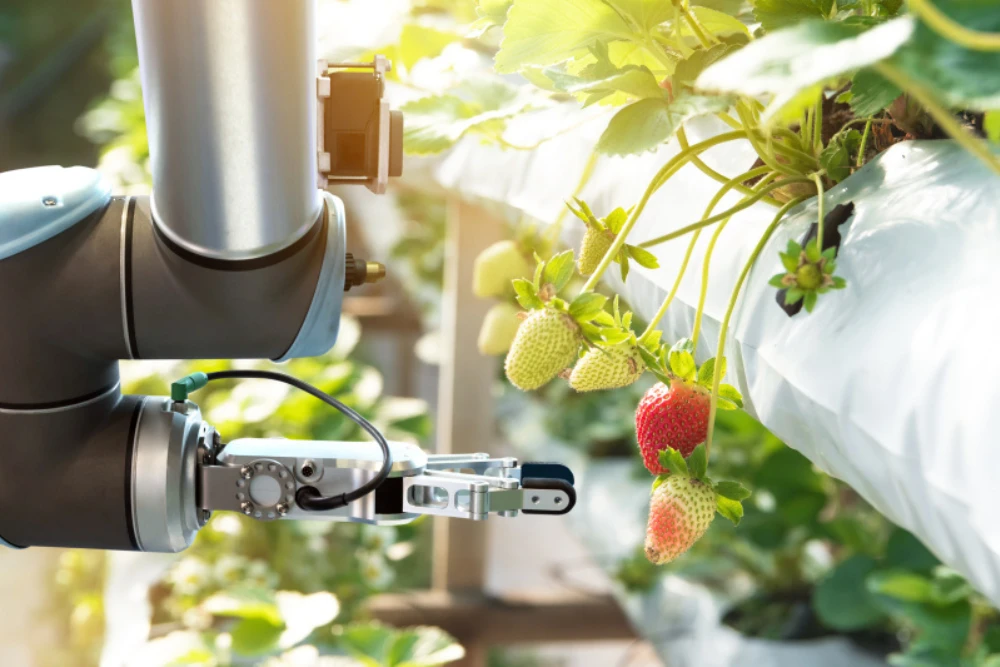
In October 2025, Bonsai Robotics unveiled their Amiga Flex robot, the first to be powered by its vision-based autonomous platform. Amiga Flex has been designed for researchers and innovators and combines a durable robot/chassis with artificial intelligence that had been trained on circa 500,000 acres and a variety of crops. The robot system can support tasks such as weeding, hauling materials, towing sprayers or mowers, and scouting crops while also enabling sensors and tools for autonomy research.
In June 2024, Kverneland Group and Dimensions Agri Technologies (DAT) announced a collaboration in precision spraying systems. DAT’s Ecopatch system, mounted onto Kverneland’s crop sprayers, uses deep learning to identify weeds and target spray, so the amount of pesticide used is reduced. Of course, this is only one of many systems available. There are so many variations coming to market that Montana State University has even created a comparison page for those considering adding precision agriculture technology to their crop spraying strategy.
The Growing Role of Imaging in Agriculture
The future of computer vision in AgriTech is about moving from observation to autonomy. Today, most systems provide insights – disease alerts, yield estimates, or weed maps – but tomorrow, they will directly drive farm operations. Drones and robots won’t just collect data; they’ll act on it, applying inputs precisely where needed, harvesting selectively, or monitoring crops continuously without human intervention. Coupling vision with IoT, GPS, and environmental sensors will allow farms to operate like intelligent, self-correcting systems rather than reactive operations.
Autofocus-zoom Technology for AgriTech
At the center of these advancements are high-resolution, low-latency camera systems. We offer a range of AF-Zoom cameras with features essential to these applications. For example, our harrier 55x AF-Zoom Camera delivers an impressive 55x zoom with a 5MP CMOS sensor.
Harrier cameras are available with a variety of video output options e.g. 3G-SDI, USB, HDMI, LVDS or IP Ethernet outputs. For 4K resolution, our Harrier 23x AF-Zoom IP 4K Camera combines superior resolution with native network connectivity.
Take a look at our full range of cameras and advanced imaging products or contact our team to find the best solution for your agricultural vision challenge.