Taking a glance at facial recognition
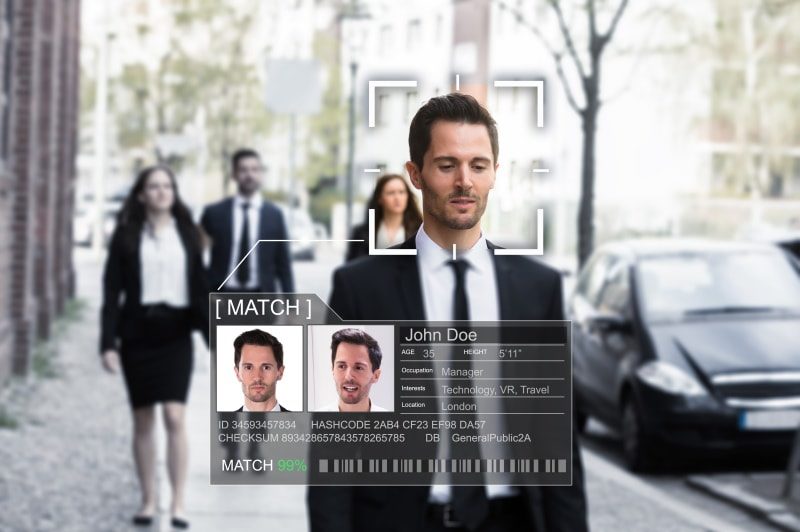
Facial recognition isn’t a new phenomenon, but the uses for it today are bringing computer vision to a mass audience. We look at some of the pros and cons of employing facial recognition technology.
How does facial recognition work?
Marketsandmarkets reports that “The global facial recognition market size [is forecast] to grow from US$3.2bn in 2019 to US$7bn by 2024, at a Compound Annual Growth Rate (CAGR) of 16.6%”[1]. Facial recognition technology relies on biometric analysis of faces obtained from images and video. The first phase is feature extraction, then object classification is applied. Spaces between key features, such as the distance between eyes, are measured to create a “facial signature”. Accurate facial recognition really requires 3D imaging techniques such as ToF sensors, stereo imaging or structured light to create a depth map. Algorithms are designed to compare and contrast features to recognize the same faces, and AI technology claims to be able to do this regardless of changes in posture, lighting, clothing etc.
The benefits of facial recognition technology
We’re all familiar with the concept of using facial recognition technology and certain uses bring clear benefits to our everyday lives. These include unlocking our smartphone, instantly sorting photos containing particular people and applying it to CCTV images to look for missing people or tracking criminal activity.
In China, the use of facial recognition technology is very much the “norm”; students are used to being scanned to monitor attendance in class, citizens know they are being watched on the street, and an unusual use is helping reduce the level of toilet paper theft in public conveniences!
DataSparQ are working on an exciting application for the pub-goers amongst us – an AI bar using facial recognition to place customers in an orderly digital queue at the bar. Facial recognition technology will decide who arrived at the bar first and should therefore be served next, removing the frustrations of queue-jumpers and depressingly long waits. With system requirements being as simple as a camera, display monitor and internet connection, the company hopes it could even be used for outdoor festivals and one-off events. Customers will be able to see themselves displayed on the screen with a number above their head giving their place in the queue and an estimated time till service. Sounds to us like a great way for computer imaging to make our social lives better!
The concerns
Of course, with such an intrusive technology, there are concerns surrounding the acquiring, storing and processing of such personal data. This is further underlined by claims that facial recognition technology is less reliable in identifying features of certain ethnic groups or gender, and is less accurate overall than fingerprint or iris scanning. While being recorded throughout your daily life is commonplace in China, some sectors of society are viewing the “big brother” movement as a threat to personal freedom and human rights. In response to a growing fear of false arrests, the state of California will now forbid the use of facial recognition technology in body cameras worn by police from January 2020, even extending the ban to running recorded footage through facial recognition software at a future time. For now, it does not encompass static cameras or federal agents.
As is often the case with new technologies, facial recognition is not without its controversies.
How do you secure a facial recognition system?
There are plenty of threats to facial recognition, such as morphing. This is when criminals merge the photos of two different people to create one image; an image that is so similar to both the original subjects that both people can beat the system. Furthermore, it has been proven possible to generate a completely artificial image for use in fraudulent passports and ID cards. Experts at the Fraunhofer Institute are working on applying deep neural networks to recognize manipulated images and combat these risks. It’s a constant challenge to stay one step ahead of the criminals but, with the right resources, it’s a challenge that can be won.
The wild side of facial recognition
In January 2023, Photonics Spectra reported a novel use for facial recognition – identifying and monitoring Harbor Seals in Casco Bay, Maine. Researchers from Colgate University have trained their system, called SealNet, on more than 1700 images of 400+ seals, hoping to be able to better understand their behavior and movements. After receiving results with 96% accuracy, the team want to add more seal species to the database. Who knows what animal faces we’ll be montitoring next?!
Active Silicon’s contribution
We’ve just released our latest camera interface board – the Harrier USB/HDMI. This interface solution fits perfectly on the smallest autofocus zoom cameras available, including the Tamron MP1110M and Sony FCB-EV series, making it ideal for surveillance applications. It provides HDMI and USB Video Class (UVC) v 1.1 output and offers remote camera control (VISCA) via RS-232/RS-485/TTL comms port or USB 3.1 (UVC) port. Together with our Harrier 3G-SDI board and SDI adaptor, the Harrier range offers real-time, high-resolution analog or digital video transmission in a variety of formats, even over very long cables.
Our experts can assist you in finding the perfect solution for your image recognition application. View our product range and contact us to understand how our technology could bring advanced computer vision to your system.
[1] https://www.marketsandmarkets.com/Market-Reports/facial-recognition-market-995.html