Global Shutter in Action: Distortion-Free Imaging Demo
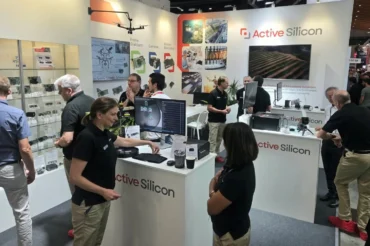
VISION 2026 was another successful show for Active Silicon. Our stand at Messe Stuttgart was busy throughout the event, giving us the opportunity to demonstrate our latest imaging technology and, importantly, talk directly with engineers about the challenges they face in real-world vision applications.
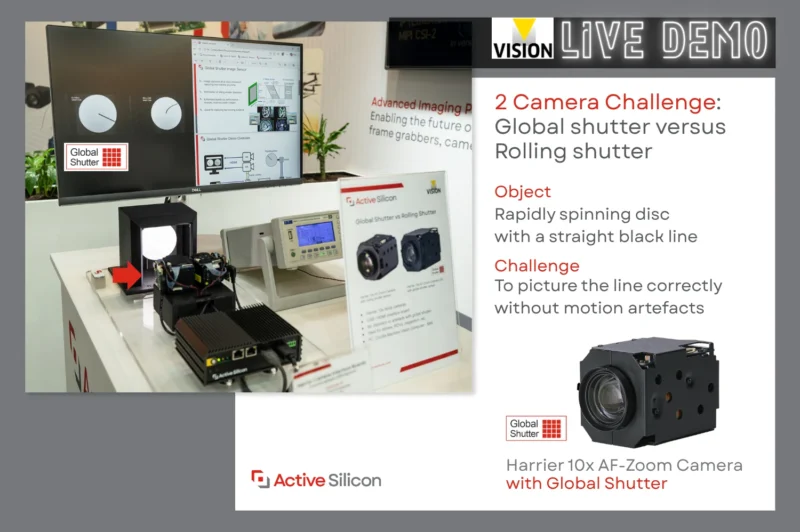
One demonstration provided a particularly simple way to illustrate an important imaging challenge: what happens when a camera needs to capture something that is moving quickly?
Our global shutter demonstration placed two Harrier 10x Autofocus-Zoom cameras side by side: one equipped with a global shutter and the other with a rolling shutter.
By comparing the cameras under the same demonstration conditions, visitors could see first-hand why global shutter technology matters when specifying a camera for applications involving fast-moving subjects or where the camera itself is mounted on a moving platform.
Global shutter vs rolling shutter
The fundamental difference between the two lies in how the sensor captures an image.
A global shutter captures every pixel simultaneously, rather than capturing an image line-by-line. This eliminates the motion distortion associated with rolling shutter sensors and makes global shutter particularly valuable when imaging fast-moving subjects.
For applications such as UAVs, robotics and industrial inspection, this can be significant. Image distortion can affect not just the appearance of an image, but the integrity of the visual data being captured and subsequently used for analysis or decision-making.
At VISION, our demonstration brought that difference out of the datasheet and into a practical setting, comparing the Harrier 10x global shutter camera directly with its rolling shutter counterpart. Both cameras were demonstrated at 1080 resolution and 60fps.
Designed for imaging where movement matters
Active Silicon’s latest additions to our Harrier global shutter range include 10x and 30x autofocus-zoom models, both built around a 3MP Sony Pregius S global shutter CMOS sensor and supporting real-time Full HD video output at up to 1080p60.
The two optical zoom options enable system designers to select the field of view and magnification appropriate to their application. Both cameras also offer day and night operation, digital image stabilisation and noise reduction.
This combination makes the cameras relevant to applications including UAVs, ROVs, industrial inspection, robotics, transport and remote monitoring, where accurately capturing moving subjects can be an important part of the imaging requirement.
More than a choice of sensor
Selecting the right camera for a vision system is about more than resolution and frame rate. How the camera connects to the wider system can be just as important.
The native video outputs of the 10x and 30x cameras are LVDS and CVBS. Active Silicon has extended the range with USB 3, HDMI and Ethernet IP options by tightly integrating a Harrier Camera Interface Board into a pre-assembled and tested camera product.
This gives engineers greater flexibility when integrating global shutter imaging into new or existing vision systems.
Bringing imaging technology to life at VISION
The global shutter demonstration illustrated exactly why practical demonstrations are so important at an event like VISION. Rather than talking about global and rolling shutter technology in abstract terms, visitors could see the difference and use that as a starting point for conversations about their own imaging requirements.
It also reflected the wider approach behind Active Silicon’s Harrier portfolio: providing camera and interface technology for demanding imaging systems, with attention to optical range, video output, control, size, environment, latency and integration.
If you missed the global shutter demonstration in Stuttgart, or you’re developing a vision system in which movement makes distortion-free image capture particularly important, talk to us about your application and the most appropriate camera and interface configuration.