Exploring the benefits of AF-Zoom cameras with global shutters
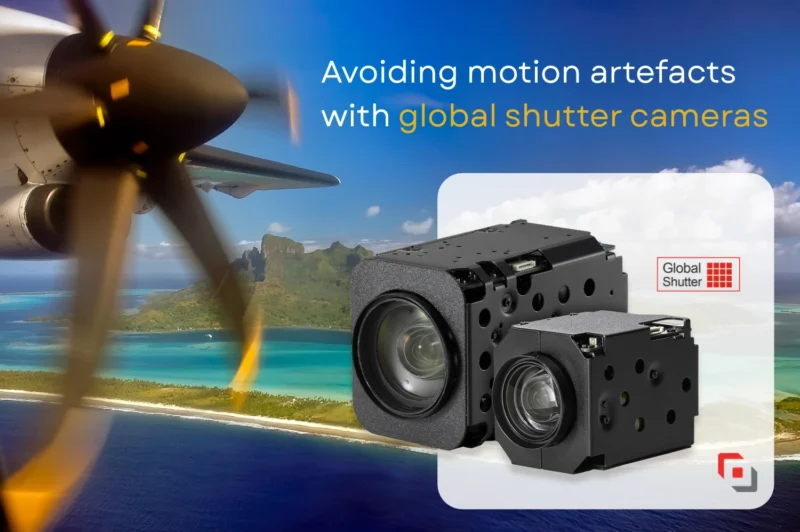
In imaging applications where the subject, camera or both are moving, the way an image sensor captures each frame can have a significant effect on image quality.
Rolling shutter sensors capture an image progressively (line by line), which can cause fast-moving objects or scenes to appear skewed or distorted. Global shutter sensors address this by capturing all pixels/lines across the frame at exactly the same time.
Combining global shutter technology with autofocus and optical zoom makes these cameras particularly useful for applications such as UAVs/ROVs, robotics, industrial inspection, transportation and remote monitoring, where both motion and viewing distance can vary.
How autofocus-zoom cameras with global shutters work
An image sensor is a semiconductor chip that has a (usually rectangular) grid of tiny light detectors known as pixels. If you read out the level of light detected by each pixel you can create a digital image that can be easily stored or displayed.
Despite the name, the global or rolling shutter in digital cameras is not a mechanical shutter, but rather an electronic function of the image sensor itself. There is no physical element opening and closing in front of the sensor. The amount of charge stored in each pixel is proportional to the amount of light received. An electronic trigger signal tells each pixel when to start collecting charge and when to stop – the trigger period is the exposure time, so a shorter trigger period is the same as a faster shutter speed. Once the exposure is complete, an image can easily be constructed by reading the amount of charge stored in each pixel.
The grid of pixels in an image sensor are arranged in horizontal rows/lines. With a rolling shutter sensor, the sensor scans progressively down the image and each row of pixels is individually exposed at slightly different points in time. During this process, if an object moves, or the camera itself moves, the position of an object in the image can change between the exposure of the first and last row. The result is the familiar rolling-shutter effects such as skewed vertical lines, horizontally sheared objects and distortion of rotating components.
With a global shutter sensor, all pixels begin and end their exposure at exactly the same time . The complete frame therefore represents the same instant in time. This eliminates the distortion associated with rolling shutter capture, making global shutter sensors particularly useful when imaging fast-moving objects or when the camera is mounted on a rapidly moving platform.
The autofocus functionality in these cameras uses software and sensors to continuously adjust the focus to maintain sharpness, even in dynamic environments. By analyzing the scene and optimizing the image sharpness, the autofocus system ensures optimal clarity and detail in every shot.
Why use a global shutter for moving subjects?
Compared to rolling shutter cameras, autofocus-zoom cameras with global shutters offer some key advantages.
- Elimination of rolling shutter distortion: Global shutters ensure simultaneous exposure across the entire frame, eliminating the rolling shutter distortion commonly seen in fast-moving scenes.
- Improved image quality: The simultaneous capture of the entire frame results in sharper, more accurate images, especially in dynamic environments where motion is prevalent.
- Enhanced autofocus performance: The advanced autofocus system continuously tracks subjects and adjusts focus in real-time, ensuring optimal sharpness and clarity in every shot.
Global shutters and CCD or CMOS sensors
Historically, global shutter cameras used Charge-Coupled Device (CCD) sensors but today they mostly use Complementary Metal-Oxide-Semiconductor (CMOS) sensors. Sony’s Pregius sensor family was a key driver for this change.
CCD sensors use a specialized architecture that allows them to capture the entire image in a single exposure. This is why CCD cameras were favored in applications such as scientific imaging, astronomy, and microscopy, where image quality and precise timing are critical.
In the past, the need for on‑pixel storage made CMOS Global Shutter sensors difficult to implement as it reduced light capture efficiency, increased power consumption and increased manufacturing complexity, resulting in larger devices and greater cost. After 2010 they became more viable due to CMOS process improvements, micro‑lens optimization, and better noise performance. Today, global shutter CMOS sensors are becoming increasingly common in drones, ROVs, industrial/inspection systems, robotics and high-end cameras.
Global shutter autofocus-zoom camera options
Active Silicon now offers several global shutter autofocus-zoom options, allowing system designers to select the combination of physical size, optical zoom and video interface best suited to their application.
Models include 10x, 30x and 36x optical zoom options. The cameras provide real-time full HD LVDS video output and can be further enhanced with a Harrier camera interface board to provide HDMI, USB 3, 3G-SDI, HD-VLC or Ethernet IP output.
These autofocus-zoom cameras have a Sony Pregius CMOS sensor and feature Digital Image Stabilization, Noise Reduction, Intelligent Motion Detection, Day & Night mode and High/Back Light Compensation. They are ideal modules for high-speed industrial inspection, transport applications, and high-resolution surveillance; for example mounted on UAVs, where they excel in capturing clear and detailed images and video, even in low-light conditions or fast-moving scenarios.
AF-Zoom cameras with global shutters represent a significant advancement in imaging technology, offering unparalleled performance and versatility across diverse applications. These cameras continue to redefine standards for clarity, precision and reliability in imaging solutions. As technology continues to evolve, we can expect further innovations that push the boundaries of what’s possible in visual capture and analysis.
View our range of global shutter cameras and contact the team to see which one will be right for your application.