From Image Capture to System Control
At VISION 2026, we demonstrated how advances in image acquisition, data transfer and camera technology can help engineers build faster, more reliable imaging systems.
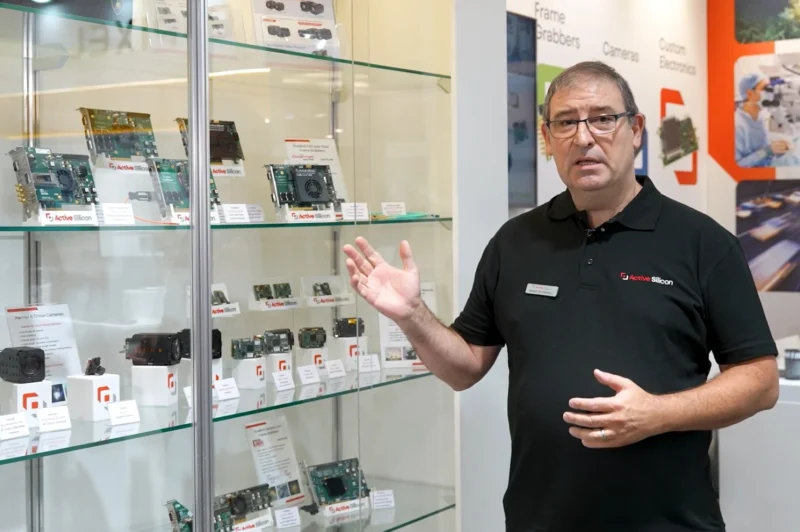
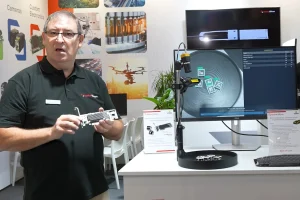
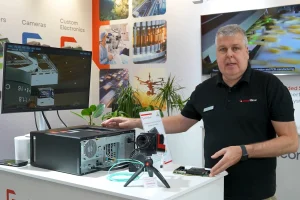
General Manager, Brian O’Connell and Head of Product and Marketing, Craig Davis, presented our portfolio from the booth at the show, watch it to see our product range and latest technologies.
The show also provided the setting for the launch of two important additions to our product portfolio: the FireBird 1xCOF100 frame grabber and our new Harrier 10x and 30x AF-Zoom Cameras with global shutters.
Together, these products address two increasingly important imaging challenges: transferring very high volumes of data over longer distances and capturing clear images when the subject or camera is moving.
Bringing machine vision applications to life
A frame grabber is much more than a connection between a camera and a host computer. As well as transferring image data, it can manage camera control, status, triggering and, depending on the interface, power.
Our ArUco Markers demonstration at VISION showed how this translates into a working machine vision application. A FireBird Dual CXP-12 frame grabber acquired video data from a camera, while an OpenCV application identified the markers in real time. The result was an interactive game that demonstrated the complete process from high-speed image acquisition to identification, classification and decision-making.
This was a fun demonstration, but the underlying principle is highly relevant to industrial imaging. Image data only becomes valuable when an application can process it and use the results to make a decision or control another part of a system.
Introducing the FireBird 1xCOF100G frame grabber
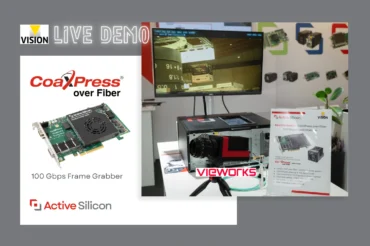
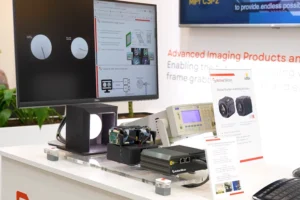
One of the product launches on the Active Silicon stand was the new FireBird CoaXPress over Fiber 1xCOF100G-4PE8 frame grabber with an exciting data transfer speed of up to 100 Gbps.
The board features a QSFP28 optical port supporting four lanes of CXP-31 data and transfers the acquired data to the host computer through a PCI Express 4.0 x8 interface. At VISION, it was demonstrated with a Vieworks 100Gig CoaXPress-over-Fiber VC-14MHF-C 670 I camera.
Moving CoaXPress communications onto fiber offers important practical advantages. Depending on the optical transceiver used, the camera can be positioned several kilometers from the control PC. Fiber also provides immunity to electromagnetic interference.
These characteristics make the COF-100G frame grabber particularly relevant to systems where cameras must operate at a distance from the host computer, or in electrically noisy environments where dependable data transmission is essential.
Its launch represents an extension of the established FireBird frame grabber range into a new generation of high-bandwidth, fiber-based image acquisition.
Global shutter cameras for imaging in motion
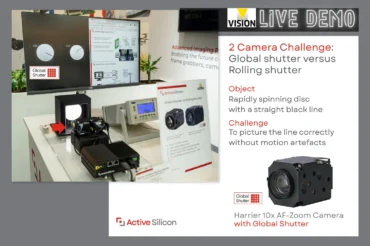
Our second major launch at VISION was the addition of Harrier 10x and 30x global shutter cameras to the Harrier autofocus-zoom camera range.
A live demonstration compared global and rolling shutter cameras while viewing a fast-moving subject. The difference is important: a global shutter captures the complete frame at the same point in time, helping to avoid the distortion that can occur when a rolling shutter sensor records different parts of the frame at slightly different times.
This makes global shutter technology particularly valuable when the subject, the camera or both are moving. Applications to benefit include UAVs, ROVs, industrial inspection, transport systems and remote monitoring.
By combining global shutter image capture with autofocus-zoom functionality, the new Harrier cameras give system designers additional options for applications that need detailed, dependable imaging from compact camera hardware.
The wider Harrier range includes cameras with higher zoom capabilities, while Harrier Camera Interface Boards can convert an LVDS camera signal to USB, HDMI, 3G-SDI or IP output.
Compact imaging for constrained platforms
The booth also featured a drone demonstration using a Harrier 10x AF-Zoom USB/HDMI camera. This showed the compact camera unit available to engineers integrating imaging into platforms where size and weight are tightly constrained.
Alongside the camera, the demonstration incorporated power, communications and laser range-finding technologies from other businesses within the Solid State Group, illustrating how imaging can form part of a broader platform-level solution.

Looking beyond individual components
Cameras and frame grabbers are only part of Active Silicon’s work. We also design and manufacture custom embedded systems that bring together image acquisition and processing with machine control, communications, networking and application-specific I/O.
The objective is to create an architecture that fits the application’s requirements for bandwidth, latency, size, power, connectivity, environmental performance and expected product life. That may involve adapting an existing Active Silicon imaging technology or engineering a fully custom platform for a particular OEM system.
Watch the video from our VISION booth to see Active Silicon technologies in action. Together, the demonstrations show how we approach imaging at a system level, bringing together image capture, high-speed data transfer, processing and control to meet the requirements of demanding vision applications.