What is Machine Vision?
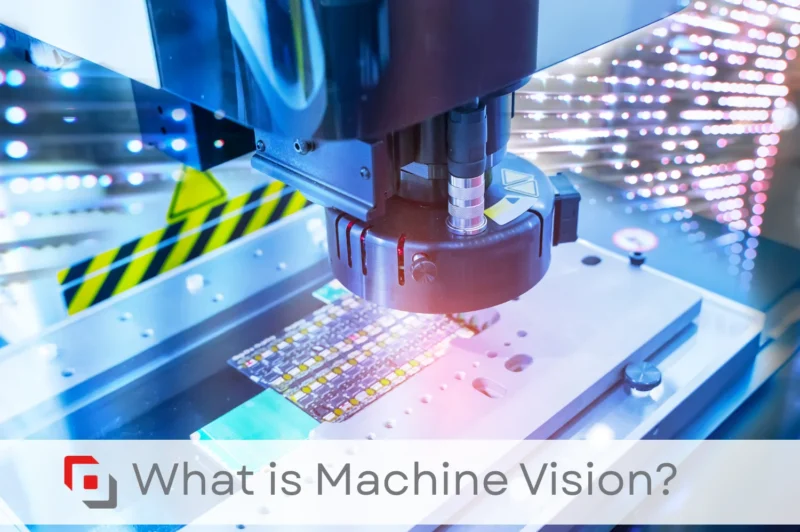
Machine vision is the use of cameras and computer systems to automatically capture, process, and analyze images for inspection, measurement, and control.
It is widely used in industrial automation, semiconductor manufacturing, logistics, and scientific imaging. A typical system combines cameras, optics, lighting, and image acquisition hardware, an imaging PC and software. In high-performance applications, interfaces such as CoaXPress and Camera Link synchronize with mechanical systems to enable reliable, high-speed image transfer to processing systems.
How Machine Vision Works
A typical machine vision workflow begins with image acquisition, where a camera captures images of the object or scene under controlled lighting and optics. The images are transferred to the host system through a high-speed interface such as CoaXPress, Camera Link, or GigE, usually via a frame grabber.
Once the images are captured, preprocessing prepares them for analysis. This can include operations such as noise reduction, contrast enhancement, color correction, geometric correction, and filtering to highlight relevant areas or suppress irrelevant information. Preprocessing ensures that subsequent steps operate on clean, standardized data, improving accuracy and repeatability.
The next stage is feature extraction, where the system identifies specific attributes in the image, such as edges, contours, corners, shapes, textures, or codes like barcodes and QR codes. Advanced algorithms can also detect patterns or deviations from a reference model, enabling precise measurements or defect detection.
Finally, analysis and decision-making evaluate these extracted features against predefined criteria. The system may classify objects, measure dimensions, detect defects, or provide positional data for robotics. Based on the results, it triggers actions such as sorting, rejecting, or guiding automated machinery, completing the end-to-end machine vision process.
Components of a Machine Vision System
A machine vision system combines optics, electronics and software. All components should be carefully designed-in together to match the application, its precision requirements, speed, and the working environment.
Core Hardware
- Lighting – Controls contrast and makes features of interest visually dominant so algorithms can separate good from bad parts reliably. Typical modules include front/bright field rings, backlights for silhouette inspection, diffuse domes for glossy surfaces, bar lights for low angle grazing, and structured/projected patterns for 3D reconstruction or edge enhancement.
- Optics – Lenses define field of view, magnification, working distance and depth of field, which together determine how sharply features appear at the sensor. Fixed focal, zoom and telecentric lenses are common; filters (polarizers, bandpass, neutral density [ND]) are added to manage reflections, spectral selectivity and ambient light.
- Camera / sensor – Industrial cameras convert photons into digital image data using CCD or, more commonly, CMOS sensors. Area scan, line scan and 3D (stereoscopic, Time of Flight, structured light sensor) variants are chosen based on part motion and coverage; key parameters include resolution, pixel size, frame rate, dynamic range and shutter type (global vs rolling). Our blog, “Selecting a camera for your machine vision application” offers advice on choosing the right option.
- Frame grabbers and interfaces – using machine vision standards and appropriate I/O, frame grabbers handle image data, triggers and synchronization with appropriate bandwidth and latency.
- Host PC – this should be equipped with high-speed PCIe slots, sufficient RAM, and CPU/GPU for processing. Machine vision uses significant processor performance, the CPU/GPU should be capable of the task.
Processing and Software
- Processing platform – An industrial PC, vision controller, smart camera or embedded system executes the imaging pipeline. For high‑throughput or complex AI workloads, acceleration via GPU, FPGA or DSP is used to keep end‑to‑end latency within acceptable limits and support multiple cameras.
- Machine vision software – SDKs and tools handle acquisition, calibration, pre‑processing, feature extraction, measurement and classification. Examples include MVTech from Halcon, Cognex VisionPro and MATLAB from MathWorks.
System Integration
- Triggers and sensors – Encoders or proximity sensors trigger the camera to capture images at the exact position of the part, ensuring consistent and repeatable imaging. Read our Tech Focus, “Real-time Triggering Using Frame Grabbers” for more information.
- Mechanical integration – Mounts, enclosures and staging control perspective, vibration, heat and contamination to ensure stable performance over time. These factors, and more, are covered in our Tech Focus, “Integrating a Frame Grabber into a Vision System”.
Machine Vision Standards
Machine Vision standards define common interfaces and protocols for cameras and frame grabbers, ensuring reliable, high-speed image transfer and easier system integration across different hardware and vendors.
Modern sensors can produce hundreds of megabytes – or even gigabytes – of data per second, making bandwidth and deterministic transfer critical. Low-latency, lossless transmission ensures that no frames are skipped, which is essential for inspection, measurement, or robotics guidance. Interfaces also handle triggering and synchronization, allowing multiple cameras or external devices to operate in perfect coordination.
Interfaces used most in industrial applications include:
- CoaXPress
- Camera Link
- GigE Vision
- USB3 Vision
Find out more about Machine Vision Standards on our website, including available speeds, connectors, cables and definitions.
Machine Vision for Industrial Applications
Machine vision systems are designed to perform a range of core tasks that enable automated inspection, measurement, and control in industrial and scientific environments. At a basic level, these tasks involve extracting meaningful information from images so that a system can make reliable, repeatable decisions without human intervention.
Industrial inspection and automation – In manufacturing, machine vision systems are used to detect defects such as scratches, cracks, contamination, or missing components. For example, in semiconductor production, vision systems inspect wafers for microscopic defects, while in pharmaceutical packaging they verify correct labeling, seal integrity, and package contents.
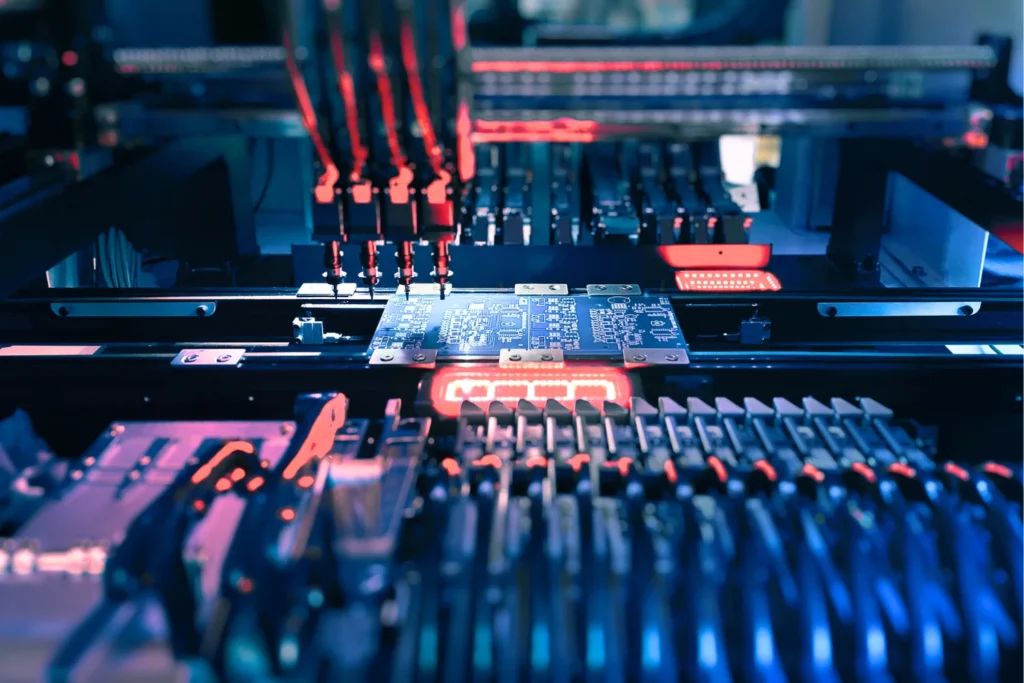
Measurement – Machine vision allows extremely precise dimensional analysis that would be difficult or impossible to perform manually at production speeds. In electronics manufacturing, systems measure solder joints and component placement on printed circuit boards. In precision engineering and metrology, vision systems verify tolerances on machined parts, often down to micron-level accuracy.
Identification – Systems can read barcodes, QR codes, and printed text to track products through manufacturing and logistics workflows. This enables traceability, inventory management, and automated sorting in warehouses and distribution centers.
Robotics and automation – Cameras provide positional information that allows robots to locate parts, align components, or guide pick-and-place operations. This capability is essential in applications such as automated assembly, bin picking, and robotic surgery assistance.
Do you Need a Frame Grabber in Your Machine Vision System?
Frame grabbers are a critical component in high-performance machine vision systems, acting as the bridge between cameras and the host computer. They capture high-speed image streams from cameras using interfaces like Camera Link or CoaXPress, ensuring that every frame is transferred reliably without loss.
Beyond simple capture, frame grabbers handle triggering and synchronization, coordinating multiple cameras or external devices with precise timing. This allows complex systems to capture multiple angles simultaneously or synchronize imaging with conveyor belts, robotic motion, or other production processes.
Frame grabbers also support hardware preprocessing, offloading tasks such as color correction, filtering, or region-of-interest extraction from the host CPU. This reduces processing load, increases throughput, and ensures real-time performance in demanding applications.
In short, frame grabbers are not just data transfer devices – they are enablers of deterministic, high-throughput, and synchronized imaging, forming the backbone of reliable, industrial-grade machine vision systems.
Add FireBird Speed and Reliability
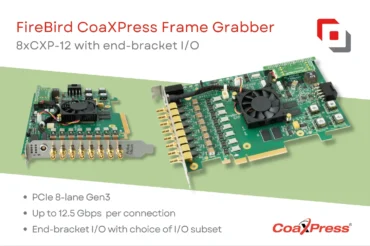
Firebird CoaXPress, CoaXPress over Fiber and Camera Link frame grabbers from Active Silicon support the fastest data rates available with our proven reliability and renowned after-sales support. Browse the full range, and contact our team for advice on selecting the right frame grabber for your machine vision application.