Tech Focus: Choosing Between CoaXPress and CoaXPress over Fiber
CoaXPress has been a reliable interface in machine vision for years, especially where high bandwidth, low latency, and deterministic triggering matter. But as systems scale up in resolution and frame rate, copper cables can limit certain applications. That’s where CoaXPress over Fiber (COF) becomes increasingly relevant.
What are the difference between CoaXPress and CoaXPress Over Fiber?
CoaXPress (CXP) has been the go-to interface for high-bandwidth, low-latency camera links for well over a decade. It’s robust, well-standardized, and can carry high-speed data, device control and power over a single coax cable.
It’s an ideal solution for high-speed machine vision systems needing 10 to 20m long cables, allowing compact cameras with low power dissipation. Power over CoaXPress (PoCXP) further helps system design, and high flex rated cables are readily available. However, cabling can be bulky and even with the highest performance cables CXP is limited to around 35m at the highest speeds unless repeaters are used. In the upcoming v3 release of the standard, CXP will extend to CXP-25 speeds.
CoaXPress Over Fiber uses optical fiber instead of coax cables to run the proven CXP protocol. Optical fiber improves performance by using light to carry data through a low-loss glass medium. Systems maintain all the benefits of CXP (speed, device control, trigger and timing architecture) and excel in applications where very long cables, galvanic isolation or operation in very demanding EMI environments is required. It’s well suited to systems with multiple cameras by reducing the bulk of the cables and QSFP cabling is a low-cost option. However, power dissipation is higher and QSFP hardware (optical transceiver modules) is large compared to many CXP cameras.
CoaXPress Speeds vs CoaXPress over Fiber Speeds
Historically, CXP speed grades have been named after the underlying bitrate of a single coaxial link. For example, a CXP-12 connection operates at a line rate of 12.5 Gbps.
While CXP and COF use the same high-level protocol, they employ different low-level encoding schemes. As a result, they achieve different payload data rates for the same physical line rate. To ensure that users can easily understand performance between camera models with either CXP or COF interfaces, both versions are marketed using the same speed designation, e.g. CXP-12. However, the actual line rates differ:
- Using coax, CXP-12 uses a bitrate of 12.5 Gbps.
- Using fiber, CXP-12 uses a bitrate of 10.3125 Gbps, which corresponds to the standard 10 Gigabit Ethernet rate.
- Both achieve the same payload data rate.
Because COF aligns with Ethernet speeds, the same optical transceivers as Ethernet networks can be used. Therefore, 4xCXP12 using fiber hardware (also referred to as 4xCOF-12) is increasingly available across camera and frame grabber vendors, typically based on 40 Gbit Ethernet optical modules that operate as 4x 10.3125 Gbps links.
The next generation COF link transmits 2.5 times more bandwidth per connection. It pushes the per-connection bitrate to 25.78125 Gbps, the equivalent of a CXP-31 link. In a four-link configuration – common in demanding machine vision setups – this provides an aggregate bandwidth of nominally 100 Gbps of image data moving from camera to host.
Like the lower-speed CoaXPress over Fiber variants, this higher speed implementation aligns well with 100 Gbps Ethernet and uses the same optical modules. Consequently, cameras and frame grabbers may be marketed as 100G CoaXPress over Fiber devices or QSFP28, which is the name of the optical transceiver form factor used for these connections.
The jump in speeds also matters because it keeps pace with sensor development. Modern high-resolution CMOS sensors, particularly in semiconductor inspection, flat panel display inspection, and scientific imaging, are pushing pixel clocks and resolutions that can saturate even 4xCXP-12 and 40G COF in multi-tap configurations. 100G COF/QSFP28 gives you headroom, as will CXP-25 when it’s launched in CXP v3.0.
What does next generation CoaXPress deliver?
- Massive bandwidth uplift: 25 Gbps per lane (or CXP-31 running on COF) delivers more bandwidth, more than doubling throughput for higher resolution and faster frame rates.
- Simplified system architecture: Many cameras can achieve target bandwidth with fewer lanes, reducing cable count, connector complexity, and overall system cost.
- Better scaling for next-generation sensors: Next-generation CXP is naturally aligned with modern high-resolution sensors (multi-25 MP and beyond), while CXP can require multi-link aggregation sooner.
- Future-proof design choice: Providing significantly more long-term bandwidth margin, meaning systems are less likely to require redesigns as sensor resolutions and frame rates continue to rise.
- Higher efficiency at system level: Even though per-lane demands are higher, next-generation COF can reduce overall link count, simplifying frame grabber port density and improving rack-level design efficiency.
- Enables new imaging architectures: Simplifying setups such as multi-camera systems or ultra-high-speed inspection lines.
Distance
This is the headline feature. Standard multimode fiber (OM4) supports COF links over distances up to 150 metres without signal conditioning, repeaters, or any of the workarounds you’d need with coax at similar lengths. Single-mode fiber extends this further – up to 2km, and with more expensive enhanced reach transceivers can deliver >40km! For factory-floor applications where the vision system is physically separated from the processing hardware – think large-format inspection lines or robotic cells with centralized compute – this changes what’s architecturally possible.
EMI immunity
Optical fiber carries light, not electrical current, which means it’s completely immune to electromagnetic interference. In environments with heavy servo drives, induction welders, or high-voltage switching equipment, this is often a necessity. Elimination of ground loops is another significant advantage to high-precision measurement systems where ground-referenced noise can be difficult to diagnose and isolate.
Cable weight and routing
A fiber cable carrying 100 Gbps of data weighs a fraction of what an equivalent copper bundle would. In robotics applications where the cable is part of a moving chain, this matters for fatigue life and dynamic performance. Routing through conduit is also considerably easier.
Electrical isolation
Because there’s no electrical path between camera and frame grabber, COF naturally provides galvanic isolation. In medical imaging, semiconductor ion or plasma equipment, or anywhere where electrical safety standards demand isolation barriers, this is a significant design simplification.
What to Consider Before Upgrading to Next Generation Speeds
Next-generation COF needs a little bit more care when it comes to the optical link. At 25 Gbps per lane, things like fiber type, connector quality, and total signal loss matter more than with 10 Gbps.
However, this is a well-established technology that has been widely used in telecommunications and data communications for many years. As a result, many existing 40 Gbps optical links are capable of supporting 100 Gbps data transmission without issue.
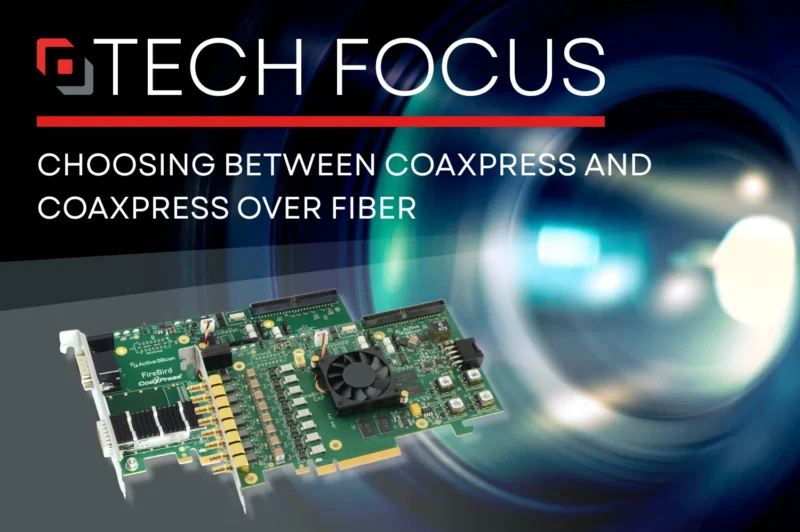
FireBird CoaXPress Frame Grabbers
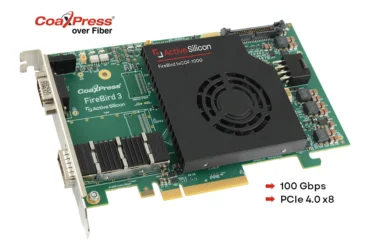
Our FireBird CoaXPress and CoaXPress over Fiber frame grabbers stand out in a few meaningful ways.
Active Silicon was one of the primary authors of the CoaXPress standard itself, and that pedigree shows. The boards’ proprietary ActiveDMA engine delivers zero-CPU image transfers using RISC-based processor techniques, something you won’t find on competing products.
Cable reach with our COF frame grabbers is supported up to several kilometres with the right transceiver choice – ideal for truly distributed installations.
The COF FireBird range also offers a data forwarding variant with a second QSFP connector for daisy-chained processing architectures. It has broad, out-of-the-box support for third-party software tools such as HALCON, VisionPro, CVB, LabVIEW, and MATLAB.
We also offer Oncilla Machine Vision Computers in CoaXPress and CoaXPress over Fiber variations for customers who want the frame grabber and ruggedized PC as a single unit.
At Active Silicon, we provide a complete, well-documented ecosystem backed by deep standards expertise for engineers starting on the CXP journey.