4K: When is it the Right Choice?
Moving from Full HD to 4K can transform an imaging system. But specifying a 4K camera is not simply a matter of choosing a sensor with 3840 × 2160 pixels.
For engineers developing high-resolution imaging systems, the real challenge is ensuring that those pixels remain useful once optics, autofocus, movement, lighting, bandwidth and system latency are taken into account.
These are challenges we see regularly at Active Silicon, particularly when integrating autofocus-zoom block cameras into industrial, defense, medical and security systems. The answer is rarely “choose the camera with the highest specification”. It is to understand how the whole imaging chain behaves.
Resolution needs the right optics
A 4K image contains around 8.3 million pixels, four times the pixel count of 1080p. That additional detail can make a significant difference when an operator needs to inspect, identify or measure something precisely.
However, resolution at the sensor does not automatically translate into useful detail at the output.
The lens must resolve sufficient detail for the sensor, while focal length, aperture, working distance and field of view all influence the final result. This is a recurring consideration in machine vision discussions, where engineers have to match optical resolution and sensor format to the required field of view and working distance rather than selecting a lens in isolation.
Zoom makes that relationship more complicated.
Long-range security, border control, UAV payloads and remote inspection systems may all need a wide field of view for situational awareness followed by rapid zoom onto a small region of interest. Optical zoom is particularly important here because it changes the field of view while preserving the sensor’s available resolution.
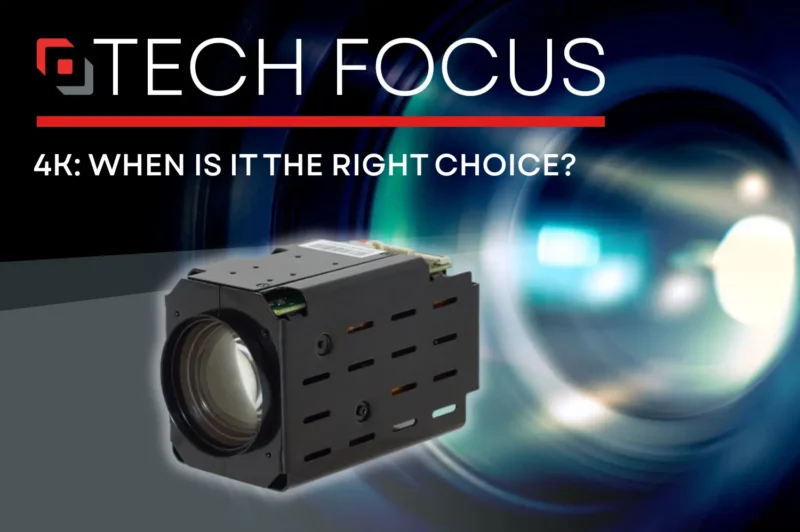
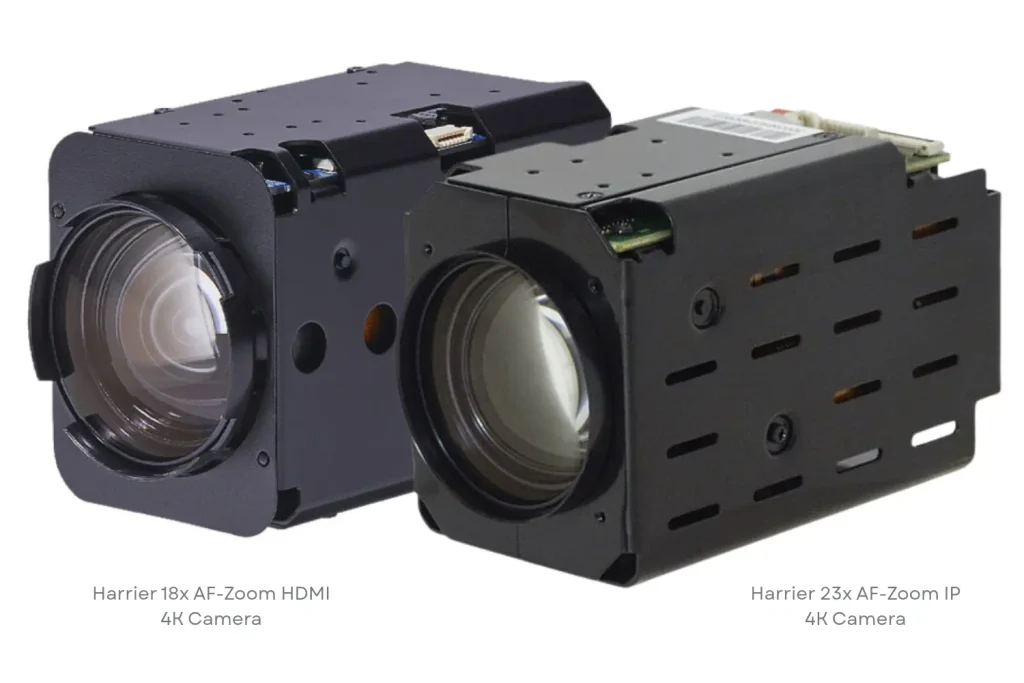
This is one reason 4K block cameras increasingly combine high resolution with substantial optical zoom. Active Silicon’s Harrier 4K cameras, for example, include 18x and 23x configurations.
Additionally, to make full use of four times the pixel count of Full HD, the optics need to resolve significantly more detail, while the processing electronics and video interfaces must handle much higher data rates. The rest of the system has to keep pace too: monitors need to support 4K if users are to see the additional detail, and recording higher-resolution video increases storage requirements. Together, these factors can add cost, power consumption and complexity to an imaging system.
Will your autofocus still perform when conditions change?
A high-resolution image is of little value if the area of interest is not sharply focused.
In a controlled inspection system with fixed objects and lighting, this may be relatively straightforward. In a UAV or remotely operated system, conditions are much more dynamic.
Subject distance changes. The camera moves. Contrast varies. Illumination can change dramatically. The operator may move rapidly between wide and telephoto views.
Several situations can influence autofocus, including low-contrast subjects, strong backlighting, reflective surfaces and fast-moving subjects. Multiple factors can prevent a camera from achieving focus.
This is why engineers should investigate further. Minimum object distance, focus modes, zoom range, lighting conditions and the behavior of the autofocus system through that zoom range all matter.
Integration testing under realistic operating conditions is therefore essential.
High resolution and low light pull in different directions
One particularly important trade-off is resolution versus sensitivity.
Increasing the pixel count within a sensor of the same physical size generally means that each light-sensitive area becomes smaller. This can make collecting sufficient light more challenging, particularly in low-light conditions.
This is not merely theoretical. Camera users regularly report differences in autofocus performance between high-resolution and lower-resolution sensors under very low illumination, with larger pixels potentially having an advantage where little light is available.
For engineering applications, the question should therefore be: what resolution can we achieve while still producing usable images in the actual operating environment?
Sensor architecture, aperture, exposure, gain and image processing all contribute. Features such as noise reduction, Wide Dynamic Range (WDR), infrared-cut filter removal and backlight compensation can become as important as headline pixel count.
For example, Active Silicon’s Harrier 23x AF-Zoom IP 4K Camera uses a 8.4MP 1/1.8-type Sony CMOS sensor and incorporates WDR, day/night operation, noise reduction and image stabilization alongside its 4K output.
Four times the pixels also means more data
Another challenge appears after the image leaves the sensor.
Moving from 1080p to 4K substantially increases the amount of image data that needs to be processed, transmitted and potentially stored. That makes the choice of interface and compression strategy fundamental to overall system design.
For local video, HDMI can provide a straightforward route to a high-resolution display or capture system. For networked and distributed imaging, Ethernet and compressed video may make more sense.
The Harrier portfolio illustrates these different approaches. The Harrier 18x AF-Zoom HDMI 4K Camera provides HDMI output at up to 3840 x 2160 at 30/25fps, while the 23x AF-Zoom IP 4K Camera outputs H.265/H.264 Ethernet video.
Neither interface is inherently the “better” solution. The correct choice depends on where images need to go, cable length, available bandwidth, existing infrastructure, processing architecture and, critically, acceptable latency.
Is latency an issue with 4K imaging?
Latency is one of the areas where a system that looks good on a datasheet can behave very differently in practice.
Engineering discussions around high-resolution IP video repeatedly highlight this problem. Users report significant increases in delay when moving from 1080p to 4K streaming, while machine vision and surveillance engineers point out that latency requirements vary enormously depending on whether an image is simply being recorded or is being used to make an immediate control decision.
For a passive security recording system, 200ms may be unimportant. For remote vehicle control, targeting, robotic navigation or real-time inspection, it may be unacceptable.
The 23x Harrier 4K IP camera, for example, uses H.265/H.264 streaming and its hardware and firmware have been designed with reducing video latency in mind. We also have measured latency information and a technical note with advice on obtaining the lowest latency with IP cameras.
Start with the imaging problem, not the pixel count
4K has opened up significant possibilities for embedded and remote imaging, but adopting it successfully requires balancing several interconnected variables:
- Required spatial detail and field of view
- Optical rather than digital zoom requirements
- Autofocus behavior across the working range
- Lighting and low-light performance
- Movement and shutter architecture
- Frame rate
- Interface and bandwidth
- Compression
- End-to-end latency
- Physical size, power and integration constraints
- System cost
This is also why Active Silicon’s wider camera portfolio spans different resolutions, zoom levels, shutter technologies and outputs including HDMI, USB, SDI and Ethernet.
The goal is not to design a system that produces the largest image. It is to produce the right image, with sufficient detail, focus, responsiveness and reliability for the decision that needs to be made.
Understanding those trade-offs from the start can make 4K much more than a resolution upgrade. It can make it a genuinely useful engineering tool for the right application.